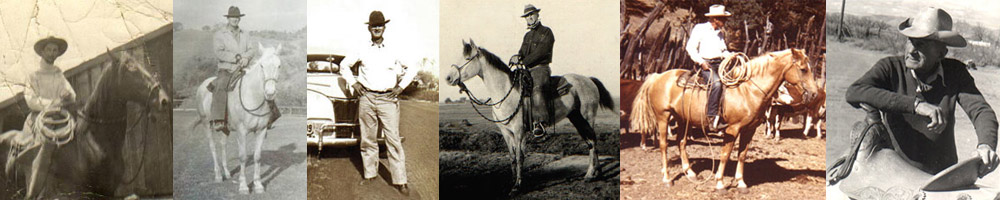




BIOGRAPHY Page 1 Ed Connell 1976 HACKAMORE REINSMAN and REINSMAN OF THE WEST - BRIDLES & BITS are historical text books and were especially written for the cowboy and the serious horseman. My father started writing HACKAMORE REINSMAN on the Quien Sabe Ranch in Tres Pinõs, California on Easter Sunday in April, 1946. Ed was unable to work outside due to a cold, miserable, and rainy day. He stated many times, "One of these days I'm going to write what I know about the horsemanship of the Old Californios." My mother had been urging him to write for some time, and so it was on this day that he began his book, HACKAMORE REINSMAN. Without her encouragement these books may never have been written. Once he started, it became almost an obsession. My mother was also responsible for naming his books and felt that they needed a romantic title. I can recall him typing by candlelight on an old typewriter. It was finally completed in October, 1948. It took almost three years to find a publisher for HACKAMORE REINSMAN…no one wanted to take a chance on it, as nothing like it had ever been published before. Jim Draper, publisher of Horse Lover's Magazine, arranged for well known Western Artist, Randy Steffen, to meet my father. At the time we were living in San Miguel, California, just outside Paso Robles. Randy sat on the fence with sketch pad in hand while my father put his horse through it's paces and different maneuvers. It was finally published in Cisco, Texas in the spring of 1952. Arrangements for publication were made by Randy Steffen. REINSMAN OF THE WEST was written while I was in high school in the mid to late 50's and was published in March, 1964. It was amazing to all of us that he never had a draft whereby he could make insertions or corrections. All his knowledge was entirely in his head, and he typed everything down one time only, step by step. Rarely did he ever have to go back to add or change anything, and he had become quite adept at typing with his index fingers. Ed Connell 1931 I have been told numerous times that when Ed wrote HACKAMORE REINSMAN, he made the assumption that the rider was considerably experienced and already had more than a basic understanding and knowledge of horsemanship. This is true. Those with less experience may find these books advanced…they should be with someone who understands these methods. He has stated in his books and articles that his books are for the amateur as well as the professional. It is my personal opinion that the interpretation of the definition of amateur has changed over the years. In those days the amateur had some experience and knowledge behind him. Today the amateur for the most part is a rank beginner who is in the throes of learning everything from the very beginning. These books are not for them…yet. But they can be in the future with practice, dedication and understanding. They are MANUALS OF INSTRUCTION only. HACKAMORE REINSMAN must be read, re-read, and studied very carefully. Dad wrote in a style that is conducive to understanding…he wrote as though he was talking to you personally. His English wasn't perfect, but that is the way he spoke. In 1995, I republished HACKAMORE REINSMAN, because the original publisher retired. It is the first half of the training process and REINSMAN OF THE WEST - BRIDLES & BITS is the second half. It was imperative that the hackamore book be kept on the market. Without it, REINSMAN OF THE WEST would be difficult to comprehend and understand. REINSMAN OF THE WEST is published by Wilshire Book Company in California. There had been some missing sentences and printing errors in the hackamore book, and it needed to be corrected and made more presentable. It is the same book. When I spoke to some of Ed's friends and a few cowboys, they all said that they hoped I would never change his writing. The fact is I couldn't, as I would not have known nor understood how. "We cowboys understand what he was sayin", they explained. All I could do was reassure them that nothing would be changed….and smile. These methods were used in Europe with the dressage horses many hundreds of years ago and can be applied to other forms of horsemanship as well. Their roots are in dressage. The horses were highly trained for fighting the many wars that occurred. This training descended from the Moors (actually pre-Moor) who in turn taught the Spanish Conquistadors. They in turn brought this training to the New World, developing the hair-trigger reined or whisper-reined horses found in California. Ed's method is pure "Californio", and he considered himself fortunate to have lived in one of the most colorful periods in the history of California. Ed & John with Max 1962 As difficult and exciting as it must have been to live in the days of the Old West, there was still something romantic about it. Most horsemen, at least the ones I've talked to would have given their eye teeth, sold their saddle (or their wife) to have been able to go back in time to experience the ranch life, cattle drives and hardships that went along with it. There is a romance and freedom and spirituality, however personal, about this way of life that is fast becoming obsolete. My brother, John, and I lived on numerous ranches when we were growing up, and many times we have wished that we could step back in time to another era. Both John and I have chosen other paths and are not in the horse world. Personally, I am extremely comfortable and genuinely pleased to be around a bunch of cowboys. Whenever I go to the Cowboy Gathering in Alpine, I feel as though I'm going home. John feels the same way. God Bless the Cowboy and the Cowboy Way of Life. What Ed knew was an ART FORM and TRADITION…a HERITAGE passed on from father to son to friend. These were the OLD WAYS…THESE ARE THE OLD WAYS AND THEY HAVE NEVER BEEN IMPROVED UPON. There has never been a short cut to perfection. THIS IS A WAY OF LIFE THAT SHOULD AND MUST BE PRESERVED FOREVER. By publishing this book, I'm trying to do my small part in keeping this work alive. This was his legacy left to every horseman. The last of the greatest horsemen of that era in the Western Hemisphere lived from the 1900's to the 1930's. He was in this group. They were all older, and they were not teaching others. They preferred to keep their training secrets to themselves, but sometimes would reveal information if they liked you. There were literally only a handful of men in the United States in the 1950's who could do what Ed could do, and they were all older than he. And none of them could or would explain a thing. He was the youngest one. Time and time again I heard him say that he was the end of the line. Ed was very lucky to have had a few of the Vaqueros take him under their wing, and it was obvious that he had a burning desire to learn. Very few opened up to him, and some things he had to figure out for himself…and that, he did. He followed the Vaqueros around so that he could learn from them, especially Luis Lupe Lugo, who became his life long friend. Jack Rose, Tom Holly, Quill Downing and Tude Wilson were also instrumental in his accumulation of knowledge. HE HELD TRUE TO THE TRADITIONS OF THE ERA FROM WHENCE HE CAME. Dad's lifetime friend and the man from whom he learned the most. Ogier Ranch 1912 A great horseman and teacher. Lupe is on front cover of Reinsman of the West. Ogier Ranch 1958 There were many top men of varying degrees, and not all top men could do what the Master Horseman could do. Only one out of ten would be a Vaquero, the Master Horseman, and that's what he was. He could do it all, and he was especially known for his headset. The horses they made were incomparable, and the horse spoke for the man by how well he worked. I've had several people tell me that Dad was the last link to the "Days of the Dons", this makes sense to me. He was. I have asked my daughter to create a definition of mastery, which she has adopted in her work as an actress. It is my hope to empower everyone who wishes to strive for perfection to use this philosophy…or at the very least, incorporate it in their work. This explanation can be applied to any craft; it most certainly applies to Ed Connell. Being a Master A true master doesn't think about commerce and demographics. They tell their own story from their particular viewpoint. That is, an opinion formulated on experience, success and most often failure. One doesn't learn from success as much as one learns from failure. A master is also acutely aware of the process of the craft. A true master takes risks in his or her art or craft. Maybe they won't be financially successful or even their own personal vision gratified. Maybe people won't understand or enjoy it; however, success is always in the risk. The master is always the student and the student the master. While predominately an Eastern philosophy, this holds the key to what mastery really is. Anyone who feels that their craft has been ultimately completed through education and experience is already unwise. One cannot continue to grow if one feels that they have nothing more to learn. A master is someone who is willing to accept that life is continuous growth and challenge. Ultimately a true master really doesn't know or believe they are a master because of an unbelievable store of generosity, humility and wisdom. Finally, a master is someone who is willing to teach and pass on his or her craft to give to another generation and ensure that the craft continues. Ed wrote his books not with the idea of making a name for himself but to PRESERVE what he knew in writing. He was shocked and flabbergasted when his books began selling all over the world; in fact, the response and respect he received was sometimes overwhelming. Even today, I receive phone calls and letters from people who have used his books exclusively referring to him as a legend or icon, telling me they would have given the world to have met and studied with him. They have told me how successful they were in training their horses, sometimes not understanding a particular point until five or ten years down the road. This is not unusual. What many people may not realize is that this training can be applied to any kind of horsemanship. HACKAMORE REINSMAN has been referred to as the BIBLE for years by everyone who used and understood it. This is a book that has to be dissected and studied very carefully. The same is true of REINSMAN OF THE WEST. One will learn if not consumed by blind prejudice. Both of these books are considered classics, are still in demand and have been on the market for 53 and 41 years respectively. The fact that HACKAMORE REINSMAN has lasted for 53 years is a testament to the knowledge, talent, ability and sincerity of Ed Connell. This in itself says everything about Ed's work, the value of both books and the respect he garnered worldwide. L-R - Edie, Gloria on King, Ed, Mabel, Wilda, Leslee, Irene Circa 1947 at the Quien Sabe Ranch Very little has been written about my father's background. He was born in Livermore, California, July 28, 1900 and was the youngest of five children born to William John and Alice Cass Connell. His father had four Professorships (mathematics, civil engineering, economics and law). He was an educator, principal and superintendent of schools in Visalia, Livermore and Berkeley. Later he taught at the Polytechnic College of Engineering in Oakland. His mother was a professor of English and a journalist. She wrote for various magazines. Ed had three sisters…one was a bacteriologist, the second a counselor and teacher and the third worked for the military in San Francisco. He had a brother, who died in infancy. He came from a family of overachievers and education was a must in his home. My father, being a free spirit, rebelled, much to the consternation of his father. For years, he became the black sheep of the family. Ed was a man who adored his mother and respected his father, although he was not close to his father, as he was a stern and distant man. However, he did buy Ed a pony when he was six years of age which was instrumental in lighting the spark that made him want to master all he could. The horse bug stayed with him from that point on. As he was growing up in Livermore, he had access to horses from his family's cook, Mary Dennihan. "Aunt Mary" as she had come to be called by John and me, had become a second mother to my father. While his family lived in Berkeley, he lived with Mary and Mike Dennihan in Livermore, California. Dad used to watch the Vaqueros play cards at Corral Hollow, and he was occasionally invited to join them in their games. Ed studied their horsemanship every chance he could. He refused to go to college and left home at the age of 17. By then he was already an accomplished rider. His education and learning was about to begin. By that time, he had met Lupe Lugo and Tom Holly who had taken him under their wing. He began training horses for the Moy and Jackson ranches. He worked hard and followed the Master Horsemen (also known as the Vaqueros) as he wanted to learn from the best. About 1929 - 1930, during the Depression, he began training polo ponies for Charlie Howard, who owned the famous race horse Seabiscuit. Ed worked the great Hearst Ranch on the King City side and became cowboy boss of the Miller and Lux Bloomfield Ranch. He cowboyed and broke horses for most of the cattle ranches in the Mount Hamilton District; the Gerber Ranch, Hubbards, Morrows, Orestimba, Oak Flat, The Canada out of Gilroy and the Ordway Ranch. During the Depression, he supported himself by entering the rodeos and playing poker with the Hetch Hetchy miners and cowboys in Livermore. He was a good poker player too. Ed's father convinced him to go back to school, at which time he took a two year non-degree course in animal husbandry from the University of California at Davis. One month before completing the course, he and his friend walked out of their class in absolute disgust. It seemed the Professor teaching this class had hardly been around cattle or in the field and they knew he was wrong about the subject matter. Ed went right back to working the ranches in California, Oregon and Nevada for several years. Ed Connell - Nevada 1933 Ed was fast becoming an accomplished horseman. He worked for D. M. McLemore in Livermore as head shipper of one of the largest cattle outfits in the west; he classified them and sent them out by railroad to headquarters in Barstow. My father was a Brand Inspector for the State of California in the late 30's when he met my mother, Irene Thornley, in Newman, California. She was born and raised in Pincher Creek, Alberta and Sidney, B. C., Canada. His promise to himself to remain a bachelor for life completely changed when he met her. They were married in August, 1941. Ed Connell Newman, California 1937 Irene Thornley Newman, California 1938 Ed Connell 1941 Irene Thornley 1941 . On this day in June, my father proposed to my mother. . Go to Page 2 BIOGRAPHY Page 2 Ranch life was ideal for my mother, as she was raised on a ranch in Pincher Creek. Ranch life was not new to her. Dad was still working for the State of California and also training horses when he was drafted into the Army in 1942. My mother went to Canada to stay with her parents until my father was finally discharged when I was six weeks old. They returned to California for a couple of years; during that time he worked for the Kern County Land Company in Bakersfield. In 1945, we moved to Elko, Nevada where he began working for Bing Crosby. He enjoyed his work there immensely; the only reason we left was because of well shafts surrounding the area. He was deathly afraid his two-year-old would fall into one. We then moved to the Quien Sabe Ranch in Tres Pinõs, California. Those three years were the happiest years of our lives. My brother, John, was born in Hollister. This group of pictures were taken on the Quien Sabe Ranch Tres Pinõs, California . Irene & Rocky 1947 Leslee on Nellie & Ed on Tommy Mapache 1947 . Irene on Nellie 1948 . Ed & Leslee Draft Horses - King & Jimmy 1946 . Ed & Leslee Horses - Hobo & Tommy 1946 John 1947 Leslee, Irene & John 1947 . Ed & Rocky - Leslee on King 1947 Ed, Leslee & John Santa Maria, California 1950 Ed on Hobo 1948 Go to Page 3 BIOGRAPHY Page 3 Ed was a salty character who led an extraordinarily colorful life; he was what one would call a natural, a TRADITIONALIST and to borrow a timely, well-worn phrase, he was poetry in motion. He was a working man, a man of ACTION and DOING, and he didn't like basking in the limelight. HE WAS A MAN WITH LITTLE OR NO EGO, a perfectionist of the highest order. Not only was he a Master Horseman (he was known as the Dean of Reinsman in Europe), he was also a cattleman. He was an ordinary man who didn't know he was extraordinary. He was a great storyteller. Among his best attributes were kindness, patience, sensitivity and above all humility. However, he had a hard time promoting himself. A humble man, he was never wrapped up in his own self-importance, but he could also be as tough as nails when necessary. HE WAS ALWAYS AVAILABLE FOR THOSE WHO NEEDED HELP AND WAS EXTRAORDINARILY GENEROUS WITH HIS TIME. Over the years, he received hundreds of letters asking for help. I remember him writing step by step explaining in minute detail everything necessary so that the letter writer would be able to understand. It was the same with the phone calls. He was not a perfect man, and he could be complicated. He did what he wanted to do, and money meant nothing to him. It was sometimes a tough, lonely and solitary life, but it was a life the Vaquero chose and loved. He did not tolerate abuse of any kind. It was not unlike him in his younger days to go after someone who mistreated an animal. That occurred a few times. He was fast and light on his feet, like a cat, possessing a keen sense of balance, timing and instinct. He had many close calls in his lifetime, but sustained only a few minor injuries. Ed always felt that the tumbling classes he took as a kid enabled him to learn how to fall. This ability helped him many times over when riding bucking horses. He always said that he had an angel on his shoulder. Ed had a hard time adjusting to a new way of life. In the mid to late 50's, horses seemed to lose their popularity, and they were expensive to keep. Many of the ranches were breaking up, being sold and subdivided. Economically, times were tough for every one; my family was no exception. In addition, Dad's age was against him. My father worked for a Realtor, specializing in ranches; my mother was a nurse. At the time we were living in Bakersfield, California. It was during these lean years that he wrote REINSMAN OF THE WEST - BRIDLES & BITS. It was published in 1964. He was known as "Whisperin' Ed" by many people. He always spoke softly and gently to the horse, and they responded to the sound of his voice. Even though I watched him closely a few times, I never heard or knew what he was saying. But I have seen unruly horses transformed the moment he walked in their presence. He seemed to have a sixth sense and could read their minds and the horses could sense that they were in very capable hands. The old-timers studied the horse's action and reaction very carefully. They learned how to anticipate what the horse was going to do. Ed at the Ordway Ranch April, 1967 Ed Connell Livermore, California 1969 In 1965, Jack Carroll of Carroll Saddle Company drove to Bakersfield from Arizona to meet and to persuade Ed to go into business with him. Carroll Saddle Company began making Ed's saddle to his specifications; his original was built in San Francisco, California in 1934. Jack also began making Ed's reindadore equipment: hackamores, bosals, spade bit, reins and romal, mecates, etc. During the late 60's and 70's he wrote numerous articles for horse magazines. Ed's working Saddle Built 1934 - San Francisco, California Ed 1973 McNeil, Arizona Ed & Lupe 1973 Trip to Reno, Nevada Ed Connell 1977 Courtesy of Ernie Morris, Vaquero Artist . Ed Connell 1974 Courtesy of Dick Gardner . In the early part of 1977, the ranch where my father was working in Livermore, California sold out; he drove to Millville, California to visit an old friend of his, Dr. Jack Chandler, whom he had known for many years. On June 1st, Dad flew to Williams Lake, B. C. Canada to conduct a clinic held by his friend, Dr. Gordon McKenzie. On June 4th, my father had a massive coronary in the arena and was gone in an instant. Needless to say, it was shocking for those at the clinic, as well as his family. Dr. McKenzie tried to revive him, but it was too late. He also told me that my father couldn't possibly have been held in higher esteem and respect than he was on the last day of his life. We shall be forever grateful that he did not suffer, as he would never have survived being incapacitated, nor would he have survived a nursing home. He just wasn't the type. I hope this synopsis has given you some insight into Ed Connell's personality, although it only skims over his life. To all those who received replies from Ed regarding training problems, would you be willing to share the letters for future publication in a question and answer segment? Ed & Jack in Millville, California May, 1977 Ed Connell - May 1977 © Courtesy of K. M. Hansen -------------------------------------------------------------------------------- REQUEST FOR INFORMATION Throughout the years and on many occasions, my dad held presentations and clinics demonstrating the California Reined Horse. They took place at: The Ordway Ranch in Livermore, California Bing Crosby's ranch in Elko, Nevada (filmed by Bing's Hollywood cinematographer) The Kern County Fairgrounds in Bakerfield, California (1958) Sonoma County Fairgrounds in Santa Rosa, California (in the early 1960's) There were many others. If anyone has films, videos or pictures of theses events, would you please contact me? Leslee Connell Schwartz 512-847-3399 lennoche@wimberley-tx.com -------------------------------------------------------------------------------- If Ed Connell were here today, he wouldn't change a thing. He wouldn't change the traditions, his method or his style in this politically correct world. There are certain terms that were used then as well as now, and they should never be changed in order to appease those who are easily offended. I cannot begin to count the number of people who have written and called to tell me that my father's books are their Bible. KUDOS to all those who desire to learn the OLD WAYS and TRADITIONS. I have the utmost respect for you. Ernest Morris's book EL VAQUERO is an excellent read and gives a history of the Vaquero and his work. For more information log onto www.elvaquero.com. This year, 2005, is the 53rd anniversary of HACKAMORE REINSMAN. HACKAMORE REINSMAN and REINSMAN OF THE WEST -- BRIDLES & BITS are classics in their field. They have stood the test of time. As I stated previously, If Ed Connell were here today he wouldn't change a thing. The following ad, written in 1952 by Randy Steffen, is as true today as it was then: For the first time, the secrets of the California hackamore men are made public! FOR THE FIRST TIME the knowledge of this almost vanished art is made available to EVERY horseman! Heretofore jealously guarded as a trade secret of a handful of skilled descendants of the old California vaqueros. Ed Connell, author of HACKAMORE REINSMAN, and one of the most skilled of hackamore experts, hands the horse world its rarest gift in history. THIS IS THE FIRST TIME the complete hackamore training method has been set down in writing. A momentous PUBLICATION! HACKAMORE REINSMAN is a valuable reference manual for the professional horse trainer as well as the amateur. Complete coverage of handling the reins ... both snaffle bit and hackamore methods; the turn on the hind feet; the set and turn; the sliding stop; starting the colt on cattle; the spin; foot position; riding a balance; correcting bad habits; keeping the horse light; and every other phase of making the finished, flashy-reined cow horse. Profusely illustrated with more than fifty accurate line drawings by Randy Steffen. This is a book no horseman can afford to be without! Written in 1965 by the late Jack Carroll of Carroll Saddle Co.: Ed Connell's latest book gives the Why and the How of making a spade bit horse out of the hackamore horse, using the methods of the old California Vaqueros. This book takes the mystery out of the spade bit and shows, among other things, that the spade in the hands of a man trained to use it is easier on a horse than even the common grazer or snaffle bits. This book tells how to choose the right bit and how to use the bit to get the most out of a horse. The use of other bits is covered as well. REINSMAN OF THE WEST — BRIDLES & BITS, the second half of the training process, covers: About Bits, Fundamental Principle of the Bit, Summary of Bridling, Purpose of the Double Rein, The Importance of a Good Start and Finish, Worn Bits, Santa Barbara Spade Bit, Half Breed, Chileno, Grazer, Snaffle Bits, Training Marks of Distinction, Carrying the Bit, Start of Using the Double Rein, High Nosed Horse, Misuse of the Romal, Straight Up in the Bridle, Knowledge and Know-How, Horse Sense, and much more. This new book by ED CONNELL contains historical and factual information and is a COMPANION book to HACKAMORE REINSMAN and REINSMAN OF THE WEST - BRIDLES & BITS. It consists of articles dating from the 1950's through the 1970's including personal letters on specific training problems. The articles provide more clarification and explain in greater depth Connell's first two books, HACKAMORE REINSMAN and REINSMAN OF THE WEST. Articles included are: Explaining Reining, The A-Fork Saddle, Swinging in the Rein, Starting Horses - Vaquero Style, Cowboy Talk, Ground-Pulling with the Hackamore, Teaching the Stop & Turn, and many more. This book is an 8.5" X 11", 144 pages, including photos and illustrations. LENNOCHE PUBLISHERS Leslee Connell Schwartz 201 Windmill Cove Wimberley, Texas 78676 Phone: 512-847-3399 Fax: 512-847-6819 lennoche@wimberley-tx.com Lennoche Publishers Hackamore Reinsman Reinsman Of The West Bridles & Bits Vaquero Style Horsemanship Web Site: www.hackamore-reinsman.com